
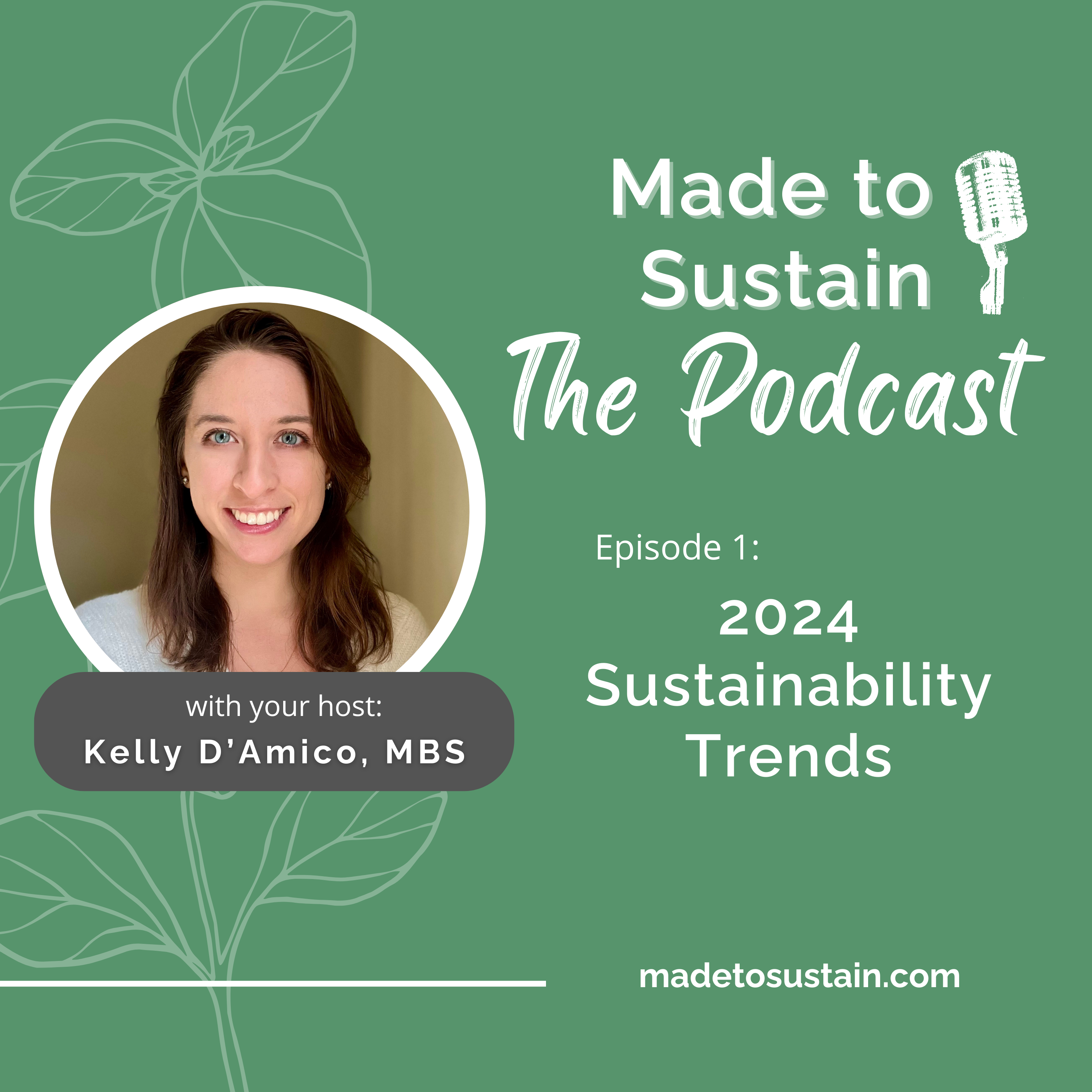
Season 1 Episode 1 Transcript: Sustainability Trends

If you prefer to read, check out the Season 1 Episode 1 Sustainability Trends Transcript here! To see the episode show notes, click here.


[00:00:00] Organic has taken the spotlight for a number of years is the most sustainable option.
But recent studies have shown that without incorporating regenerative practices into agriculture. Organic farming practices can actually erode soil nutrients away just as much as conventional farming. So meaning that over time, there's not going to be much difference between organic and conventional farming in terms of what's more nutritious, but, the great thing about sustainability is that. , we can always make improvements and we're always learning something new. Hey, welcome to the Made to Sustain podcast. I'm your host Kelly D'Amico and I'm thrilled to help guide you on the journey to make better food choices that are made to sustain you and the planet.
Over the past eight years, I've worked in the food industry, understanding food production, manufacturing, and sourcing. I have a bachelor's degree in food science and a master's degree in global food technology and innovation. I've spent the last several years of my career, learning about [00:01:00] sustainable sourcing and sustainable product development. I started my blog Made to Sustain, to share this information with those who really want to make an impact and it's been a lot of fun and I'm so excited to introduce the podcast to communicate food sustainability in a simple way to help you navigate decisions when you're in the grocery store. Or when you're making yourself dinner, ,
because having to worry about what you're going to eat is a hard enough decision sometimes.
Over the past year or so, I've been looking out for different sustainability trends because sustainability is complex. There's no silver bullet for a more sustainable future.
And many companies are looking at taking climate action. Today, we're taking note of the key trends that you should be looking out for this 2024 that will have a positive environmental impact. And dive into what they mean. Each episode this season, we'll cover an in-depth deep dive of each topic that we're covering today. And we'll have some special guests that can help you explain what they're doing and what their [00:02:00] mission is.
If you want to learn more about how to make sustainable food choices, you're in the right place.
So let's get started.
Regenerative Agriculture
One of the biggest sustainability trends that you'll see this year is regenerative agriculture. And it's gaining a lot of popularity for good reason. Regenerative agriculture is more of a farming philosophy that mimics nature's own way of working. . , because it prioritizes soil health as the foundation of everything. The practice focuses on. Supporting biodiversity loss and soil restoration. And there's some new studies that have come out. That focus on how regenerative farming helps increase the nutrient density in foods. Organic has taken the spotlight for a number of years is the most sustainable option. But recent studies have shown that without incorporating regenerative practices into agriculture. Organic farming practices can actually erode soil nutrients away just as much as conventional farming. So meaning that over time, , there's not going to be much difference [00:03:00] between organic and conventional farming in terms of what's more nutritious., but , the great thing about sustainability is that. , we can always make improvements and we're always learning something new.
Yes, regenerative is more expensive because it costs the farmers more money. They've really got to change up their whole way of working. And that requires some investment. , but it's better for farmers' livelihoods. It's better for climate resilience. , and it's better for their economic stability. It helps promote and nurture local ecosystems and provides habitats for pollinators and other key species. While, the definition of regenerative agriculture is still yet to be decided on the NRDC. So the natural resources, defense council. , provide some great insights, which I'll link in the show notes below. Be on the lookout for a new seal called the regenerative organic certified. It's also listed as ROC, and they've got an audit system where they're able to certify whether or not these crops have been grown with regenerative practices.
So make sure you're on the lookout for regenerative agriculture [00:04:00] and regenerative practices. Because they're really important to, , combating climate change and preserving our food system.
Upcycling and Circularity
The next trend on our list for 2024 top sustainability trends is upcycling and circularity. This trend stems from the problem that one third of food every year goes to waste. And when it goes to waste, it sits in landfills. . Food that sits in landfills actually produces methane, which is 25 times more damaging than carbon dioxide.
Upcycling is the practice of taking this food that would. Typically, they go to landfills and create new viable products. That goes into new food products or other types of products. It's no wonder that many companies and people at home are looking to take action to reduce food waste through upcycling. We have a few posts on this, on the blog, like how to upcycle orange peels and how to upcycle used coffee grounds so that they don't go to food waste. Later on this season, we'll talk to some [00:05:00] brands who can share a little bit more about the practices related to upcycling and how they use it within their products. We'll be diving in more with. Renewal mill later this season to uncover how upcycling actually works in practice. So make sure you follow along this season to learn more about upcycling.
Plastic Free Packaging
The next trend on our list is biodegradable and plastic-free packaging. Packaging is one of the first things that a shopper will see in the grocery store.
Many products that are on the store today, come in plastic packaging. And if you didn't know. Only 7% of our plastics are properly recycled, meaning that the single use plastics. Create mountains of plastic in. Oceans along beaches and they really just ruin our natural landscapes. Plastic has been found and even some of the most remote regions of the planet. It's a real problem because we don't know the longterm effects of plastic.
This is why biodegradable materials and plastic-free packaging have really [00:06:00] taken a stance to combat this problem. There are a lot of nuances with biodegradable and plastic-free packaging. But if we get it right, it will really revolutionize how we protect our food. From things like mushroom mycelium to seaweed, to brown cardboard.
Even the biodegradable or compostable ones work alongside food scraps to enrich the soil instead of polluting it. Plastic packaging. Isn't as simple as you might think to replace. So later on this season, we'll talk about some things to look out for, uh, for sustainable packaging. For biodegradable material. And how packaging can contribute to a circular economy.
Traceability and Transparency
The next trend on our list is traceability and transparency, which really stems from the farm-to-fork movement. The farm-to-fork movement became popularized in the early two thousands.
I'd say there were a few prominent authors who wrote books on the topic. And some chefs began to speak out about the importance of sourcing local ingredients. For example, where does our food come from? Are the [00:07:00] animals raised humanely? These are all questions that people really want to know about where their food comes from.
It really stems from some of the challenges that we saw in the COVID pandemic, where. We realized that our grocery stores were empty because. We couldn't get food in from Asia, food got stuck in the Suez Canal, and it really shined a light on how broken our food system is. And don't get me wrong – It's great to have a globalized food system where we can source food, fresh food from all over the world, but it's not entirely sustainable. As we saw with the COVID pandemic, where. There were some issues with the supply chain, leaving food shelves, barren, for weeks.
And even as someone that worked in the food industry, I didn't quite understand the globalization of the food system until I walked into a grocery store and I saw empty shelves everywhere. And this really just spoke to me. Saying that our food comes from all over the place. Our supply chain [00:08:00] was so disrupted; a simple ingredient stopped all of production, and you couldn't get food on the shelves. And I think that now people just really want to understand. Where does their food come from? , and why does it need to come from so far away? When we have local farmers that live in our backyard?
Traceable food and transparency build trust, and it empowers people to make sustainable food choices. To support ethical production and ethical producers. And really understand the value of their food. Um, the amount of effort that it takes to grow this food. So I think traceability and transparency will continue to be something that consumers want to know more and more about and rightfully so you have a right to know the food that you're eating and where it comes from.
Now this trend has been going on for a bit. Uh, and it's called traceability. Traceability really started with the farm to fork movement, which has been popularized since I'd say about the early two [00:09:00] thousands. some of the best restaurants promote themselves as farm to fork but I think they want a little bit more transparency within their food system. , So, things like eggs. Right? We want to know more about the conditions in which, how the chickens or how the hands are laying their eggs. Right. Do they have room to roam? Do they have. Access to the outdoors.
Are they crammed in a tiny cage where they can't move? All of these things are really important. Whether you view it from an ethical practice or from a nutrition aspect. Uh, there's been, there's been proof that the food that's produced. Um, by healthier animals or. Just in better environments, all, all around. Um, contain more nutrients overall.
Made with Local Ingredients
Building a little bit on the traceability and transparency trend, another one that comes to mind is made with local ingredients. So it's, it's not just a matter of. How far has my food traveled, but highlighting just how broken our [00:10:00] food supply chain really is. , it makes sense to source products more locally. , not to mention the. The shared, um, the food miles that it takes to get food from one point to another. It also contributes to carbon emissions.
Right? Sometimes, they need to be put on a plane. Sometimes, they need to be put on a cargo ship. In order to get from one point of the world to where you are. And that doesn't always translate to the best quality of produce. While transportation companies are looking at things like electric vehicles and electric planes, it's too new of a technology to replace an entire distribution fleet.
So we're really a long ways away from making any kind of carbon neutral or offsetting carbon emissions from sourcing food from another point of the world. Sourcing ingredients. Isn't just a fad. It also helps support your local community and the environment. It supports local farmers. It gives you better. Quality products because they're fresh.
They're in season. , and you get to celebrate the seasons in the fresh produce that comes from your own backyard as grown so [00:11:00] close to home. One more thing to add about local ingredients is that it really gives certain regions a point of pride in talking about the food that's grown in their backyard, which I think is really fun because it gives farmers something to be proud of and community something to be proud of. One example of this is, , and they did a whole sketch on this on Portlandia. About how Oregon they've got the Marion Berry, right? And in Portlandia it was, everything was married and very. But I think it's fun. Like me being from New Jersey. We have so much pride in a summer Jersey tomato because there's really nothing like it.
It gives you a sense of identity. But it also makes you excited for a new season, um, and to look forward to the crops that are coming, and as somebody who really enjoys cooking, I think local ingredients. , and sourcing local ingredients are going to , become even more popular with, with restaurants, , with restaurants selling food, into finished products, right?
Like buying your own sauces or dressings from a restaurant. , I think there's a lot to come with local [00:12:00] ingredients, , and regionalized ingredients to that point as well. We're really focusing on sustainable, seasonal food this year. So make sure you check the blog for our post on that.
Human Rights & Ethical Sourcing
The next trend on our list is something that's not often talked about. And it's because the topic is pretty heavy. But it's really important. So, human rights and forced labor are now going to be taken. , a place in people's minds when they're doing their shopping and the fact of the matter is that the food that we eat shouldn't come at the cost of someone else's suffering. Forced labor and unfair working conditions have tainted our food supply chain for a number of years.
And we haven't really seen any backlash from it. Uh, until recently. You may have seen in the headlines, there were some big companies like Nestle and mandolins who were really put in the spotlight for not. Choosing. Ethically sourced chocolate or cocoa. When their, , commitments to the street and what they had shared with investors, where that, you know, they were going to be sourcing 100% ethical.
[00:13:00] So choosing things that are ethically sourced means demanding transparency from your suppliers and supporting producers who value human rights and refuse to be complicit and worker exploitation. So there's been certifications, like fair trade. , that have been around for a number of years that really work to raise awareness about ethical labor practices. But don't be afraid to ask questions or do a little research when it comes to this. We're going to be doing a deeper dive on what does this mean?
And how do companies have social sustainability? How do they source ethically? And how can they make a commitment and really deliver on their sustainability goals? And what you should be looking out for later on this season. So make sure that you tune in for that episode. It's really important.
And it's not really talked about as much as I think the topic deserves. So we'll be, we'll be looking in a little bit more on that later this season.
Addressing deforestation concerns
The next topic that we'll be looking at this season is around addressing deforestation concerns. While [00:14:00] deforestation typically refers to the rainforest. , it can mean the clearing of any natural landscape. And the reason that this is important is because rainforests are vital for biodiversity and for climate health. we clear the land to grow certain crops like soybeans and Palm oil. These are important crops in the food system, but 70% of the crops are grown. , Is actually intended for animal agriculture and to feed animals.
Rainforests are vital for biodiversity and for climate health because they have so many untapped and unexplored species. And because of how much like plant life botanical life, there are sequesters, the carbon, and helps control our atmosphere and atmosphere conditions.
They're more important to the climate than we understand. And I think things like the Rainforest Alliance certification little iconic gecko that we've seen on a lot of our bananas, they're going to become table stakes. There's really no need for when we have plenty of arable land, and we don't need to clear the rainforest for them. Some things you can do [00:15:00] to address deforestation concerns, um, while it might not seem like the first choice opting for plant-based meals more often. Choosing locally sourced, sustainable meat and dairy and supporting deforestation.
Free initiatives can really make a difference.
Mindful Consumption
Okay. So the last trend on this list is going to be around mindful consumption. And while you might not automatically associate this with sustainability, I think you'll find that it really ties in with all of the trends. Um, that we've been seeing. Um, in a world of abundance, it's easy to forget the true purpose of food, which is really to nourish us, to connect us, and to celebrate with others. It reminds us to appreciate every bite. Savoring the flavors and the textures of each food and the sourcing of the ingredients and where they come from and just appreciating everything that comes together to bring food to your table and the company that it brings. With the cost of ingredients going up, , it means people are going to be [00:16:00] more intentional with planning their meals, avoiding impulse buys and cooking with intention. I think this will also translate to things like turning off distractions while we're eating, engaging in conversations around the table, and cherishing a shared experience. Mindful consumption can even translate into things like, , intentionally choosing things that, alter your mood in a functional way.
So things like adaptogenic mushrooms, and selecting these over maybe a cup of coffee or. A can of soda or a reduced-sugar beverage is a way to still. I enjoy that experience of drinking a soda but without the trade-offs. Mindful consumption is a way to reevaluate the food that we're eating. And making sure that we have a healthy relationship with food and a healthy relationship with where it comes from.
Thanks for Listening!
And that's a wrap, that's it for our very first episode, from the made to sustain podcast. I hope you enjoyed this first episode about the 20, 24 sustainability [00:17:00] trends. As I mentioned throughout the show, be sure to. , subscribe to our channel, and follow us along on our journey because we're going to be doing a deep dive into each one of these key trends and and what they mean from things like regenerative agriculture. To upcycling and circularity, traceability and transparency, and deforestation.
Because the first way to repair a damaged food system is to understand how it works and how it operates.
I think it's really important that all of these trends combined and coincide together to create a more sustainable food system.
So be sure you follow us along. We'll be having special guests on each episode that are gonna help us understand. What do these different trends mean? So, thanks so much for joining us along on this first, very first episode.
I'm so excited. Be sure to give us a rating, and follow us along on my website, madetosustain.com. I can't wait to share more about what it means to have a sustainable food system because we can't love our planet without [00:18:00] loving the environment, too. So, so excited. Thank you guys so much, and have a great rest of your day! Bye.
Discover more from made to sustain
Subscribe to get the latest posts sent to your email.


